Big Walk is the latest release from House House, Aussie indie development studio, based in Melbourne, who rose to fame following the success of the wacky and charming Untitled Goose Game. It has spent the past six years in development, birthed from inspiration that struck the developers during the COVID-19 lockdown of 2020. This inspiration is the game’s golden thread through which everything about Big Walk is connected; communication between friends – an idea that kept us in touch, even when we were unable to do so physically back during lockdown.
There have been a multitude of titles over the past few years which have seen enormous popularity in the emerging genre of so-called “friendslop”; casual multiplayer fun with friends. Among Us, Phasmaphobia, Content Warning, Meccha Chameleon and Peak just to name a few, but there is something special going on in Big Walk that sets it apart from its contemporaries. In the devs own words, the aim of the game was to “give enough direction for the group to keep a good momentum, but relaxed enough that you’re mostly just able to enjoy spending time with your friends”. It’s a difficult balance to strike, but I can confidently say that Big Walk achieves this spectacularly.
Talk To Me


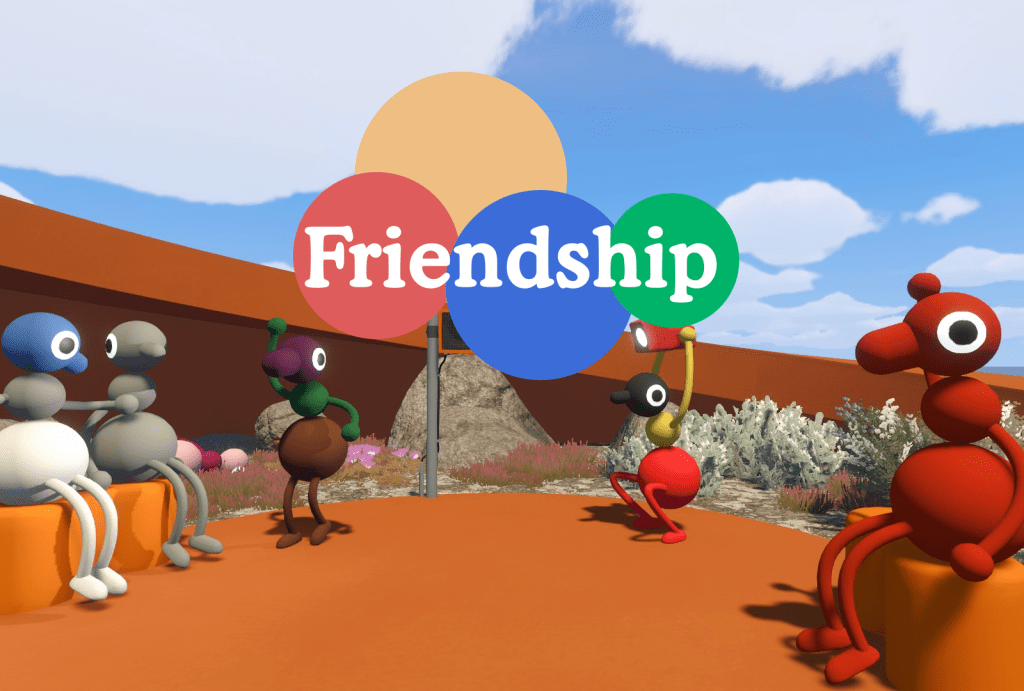
Communication is the absolute essence of Big Walk. Every inch of this game is inherently tied somehow to it, from the proximity chat, to co-operative puzzles, to the array of items you find along your travels. An excellent example of this essence at play is the character customisation area (affectionately referred to as the “palette palace” during my playthrough) where you are able to alter the colours of your character. Or, more specifically, you are able to alter the colours of other players’ characters. It is literally not possible to change your own colours, so you must rely on your friends to do it for you. And here, in this moment, you are learning how to play Big Walk. You have an outcome in mind – you want your character to have a blue head, for example – and you need to converse with your fellow players in order to reach this outcome. And once you’re sorted, it will undoubtedly fall to you to paint your pals their desired colours. It’s an entirely optional endeavour, of course; this serves no purpose in progressing you any further in the game. But, the “palette palace” is visible as soon as you leave the spawn area of the game, so every play group is naturally going to let their curiosity lead them there. And, once you are painted your desired colour scheme, your friends will need to memorise your colours to be able to recognise who you are, because there are no player names visible during gameplay. Again, the invisible hand of Big Walk is at play here, guiding players towards organic solutions and nurturing communication. We’re social creatures, and we’re particularly social with our friends, so by asking us to get together in a game and communicate, everything about this game feels immediately natural.
Less is More


Everything about Big Walk is deceptively simple. From its minimalist character designs to its playful, Lego-like structures and monuments, it is visually straightforward and almost plain in a way that is incredibly striking. Juxtaposed against the more realistic and detailed environments (more on that below), the simplicity of the game’s functional pieces such as its items, puzzles and characters, is emblematic of the design philosophy at play. None of the game’s puzzles I have faced thus far are particularly complex – the difficulty usually lies not in working it out, but rather being able to successfully undertake the solution with enough co-ordination to succeed. The game trusts that players will be able to experiment with whatever they stumble upon, and, through trial and error, iteration and teamwork, achieve great things.
Big Walk offers nothing in the way of overbearing cut-scenes, complex narratives or hand-holding tutorials. Instead, it simply plops you onto an island without a morsel of context, and through intuitive world-crafting and simple colourful design, subtly guides you towards entertaining activities and exciting things to see. From its plethora of useful items and gadgets to its layered gesture system, Big Walk never feels overwhelming. There aren’t even any threats, per se – no enemies, no fall damage, no hazards. The only threat as such is the possibility of getting lost, especially at night, which encourages players to keep light sources on them, and to keep in close contact at all times. This simplicity means that it’s never overwhelming, and every system at play here is innately understandable from the very start, serving only to bolster that golden thread of communication. It is so confident in the players and both their abilities and their curiosity that it lets them take the lead, and to great effect.
The Great Outdoors


House House have spent hundreds of hours in this game, playtesting and tweaking, in order to create the authentic and immersive sense of being outdoors with your friends. Big Walk‘s outdoors environments are inspired by the Wilsons Promontory National Park in Australia, providing the ideal sandbox for exploration, traversal, and beautiful scenic adventures. I’ve mentioned the puzzles a few times so far, and they are absolutely an important component of the game, but I have neglected the other half of the experience which is what makes Big Walk so much fun: traversal. The game world is a hand-crafted island full of mountains, beaches, tunnels, forests and streams, with a gorgeously dynamic day-night cycle which makes the entire place feel alive. Its excellent sound design immerses you in the dense woodland or the serene beaches, and this backdrop makes for the perfect setting to sprinkle the game’s content around. You and your friends will always have an objective in mind, but it’s that downtime between destinations that has often been most memorable for me; discovering strange new structures with pals, chatting casually on our way to our next stop, or simply stopping to dance at the beach for a bit after discovering a new tune on our portable radio.
Big Walk is not afraid of letting players take things at their own pace, and giving you access to items and locations which functionally serve no practical purpose. It acknowledges that things can be fun simply on their own merit – not everything needs to have a point. A great example is the myriad of benches and seats littered around the island – they’re functionally pointless, but their placement has encouraged several moments of downtime along my travels, where we have just sat and admired the view for a moment, or sat down to wait for other players to catch up with us.
Riddle Me This

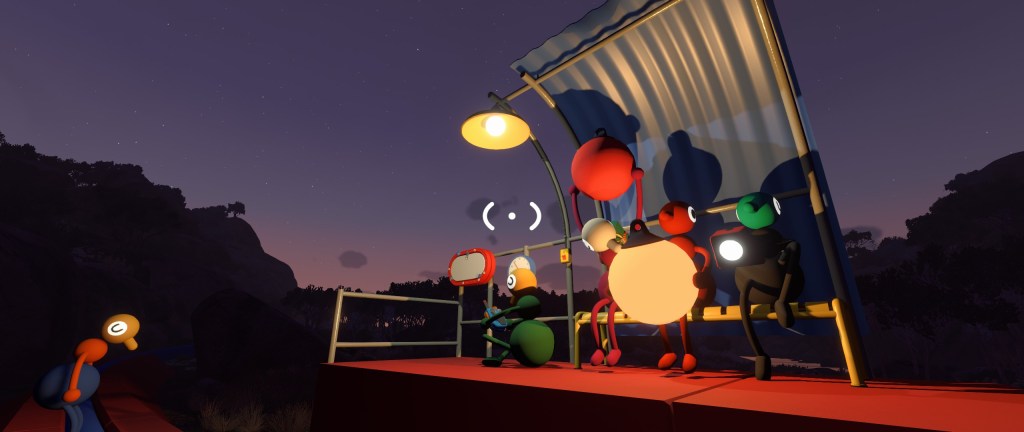
All of the game’s puzzles play with the concepts of teamwork, timing and information-sharing. They range from simple, singular activities that rely on co-ordination, such as pressing four buttons in sync, to more abstract and requiring interpretation. Again though, simplicity is the name of the game here. Even puzzles which had initially stumped us have turned out to be fairly straightforward asks – it is the tools that you are given, and how to use them, which end up becoming the true challenge. Big Walk returns to ideas and concepts you have already succeeded with previously and builds upon them in order to ramp up its difficulty, but it never feels like it is reaching too far or asking too much of the player. There were certainly moments of frustration and confusion across my 8hrs or so of playtime thus far, but this always came with levity and amusement, as it was always our own misinterpretation, or lack of co-ordination, that was letting us down, and it always resulted in laughs as a result.
Friends Forever


This leads me to the summary, and real thesis, of this piece. Big Walk does use communication as its golden thread, yes. It also uses simplicity and intuitive design to guide players, sure. It celebrates downtime and fun for fun’s sake, true. But, more than anything else, Big Walk is a platform upon which friendship is celebrated.
Every single moment of my time with this game has been spent with an enormous smile upon my face, and that is because I have been experiencing it alongside my best friends. Stupid in-jokes and banter that finds its way onto in-game signs and text messages. Small, quiet moments of intimacy where you and another player end up getting lost and having to find your way back at night to regroup with your pals. The rush of excitement when you figure out a puzzle, and actually manage to pull it off in sync with your gang. Firing dozens of flares inside an enclosed space mid-puzzle and feeling like you’re on the set of Apocalypse Now. Jumping into the ocean simply to show everyone how ridiculous the swimming animation is. All of these are small moments, but they are moments that you couldn’t script; you couldn’t plan for, and you can never recreate, and they culminate to create an experience that is far more than the sum of its parts. Big Walk is a vessel for emergent moments of pure joy with your friends, and it is an absolute triumph.
I have played quite a few games this year, but the most fun moment-to-moment gameplay I have experienced has definitely been in Big Walk. I really do think that House House deserve every bit of praise that they are getting for this game – they have managed to craft such an excellent playing field for people to get together and just be in, with their friends. Whilst reading into the studio for this article I also discovered that they are a very small studio – their core development team consists of just four people. I’m now even more impressed. If you have a few friends (up to 12!) who can join you for the journey, there is nothing I can recommend more right now than to go for a big walk.





Leave a Reply