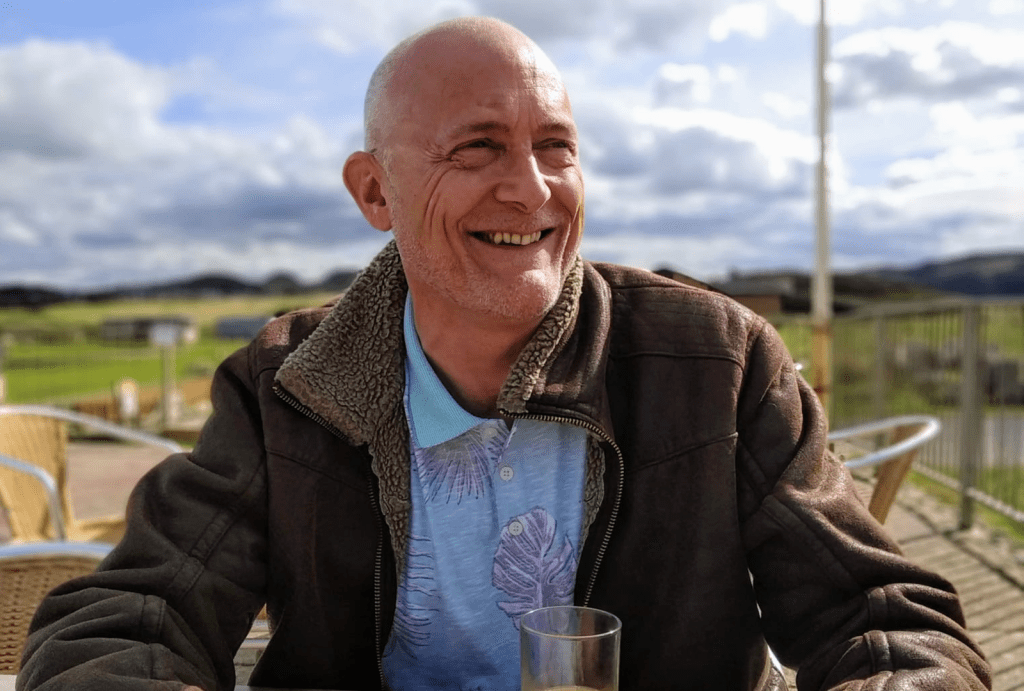
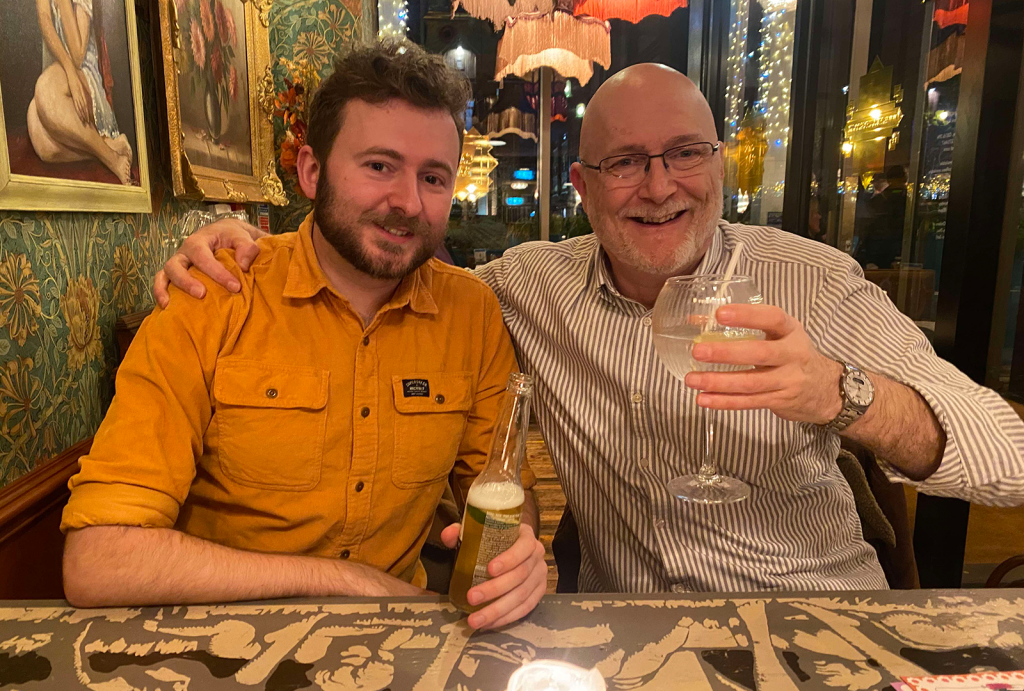
The Game Over Archives is very proud to share with you an exclusive interview with a veteran developer whose career spans three decades, from the early days of the ZX Spectrum to modern PC…who also happens to be my dad.
El: Hello Steve—Dad—which would you prefer? Thanks a lot for taking the time to chat here on The Game Over Archives! How would you introduce yourself in the context of your career – I understand that you dabbled in art, programming and design?
S: Haha, Steve, dad, retro-guy, whatever! [Laughs] Pleased to chat about these awesome and very unique times! I have a great nostalgic feeling when it comes to the early 80s, what a unique and incredible juncture it was – tech, music, culture, just about everything was colliding and undergoing seismic changes, and it was great to be on the roller-coaster!
For the record, I taught myself to code, got big into art/graphic design/game design, and just about became a one-man-band (well, often 2-man band, or sometimes 3, including music, which another mate did).
El: I know that you worked at Deep Red in the 1990s up to the mid 2000s working primarily on PC tycoon strategy type games – Beach Life, Monopoly Tycoon, SeaWorld Tycoon, Risk and the like – but how did your career in the industry begin, and can you tell us a bit about what it was like working on games while the medium was still in its infancy compared to today?
S: The formative years – certainly for me – were the late 70s and early 80s. I was born in ‘67, so 1980 would have been my first teenage year! I was absolutely fascinated by computers and followed every development with something of a religious fervour – hard to imagine now, but this was a time post-Star Wars, but pre-Internet, pre-mobile phone, pre-pretty much any kind of tech we know today!
But I digress. Games were almost non-existent at the time, and so it was a thrill to make these futuristic lumps of plastic follow your bidding! In 1980, when the ZX-80 launched, I couldn’t even afford one (about £50 in kit form at the time – that’s almost ~£300 in today’s money supposedly!?). Anyway, a friend and I clubbed together to buy the manual (only!) and taught ourselves Z80 machine code from it!
We later managed to buy a ZX-81 kit, soldered it together, and started to design/write basic games, before the advent of the ZX Spectrum, which changed everything again. That was where I truly learned to code (well!), create graphics, and design early games (based on what we were seeing in the arcades)!
Hard to believe now, but my computing buddy and I hand-recorded cassettes directly from the ZX-81 we’d built, and sold them via a local shop in Manchester. That was a company called A&F Software (of Chuckie Egg and Cylon Attack fame). It was just a breathtaking time really!
El: Wow – working with the real basic building blocks of gaming then, and just teaching yourselves! And where did that take you from there?
S: For the longest time, my friend and I continued to hone our skills and release a raft of game titles, originally as a sideline whilst working a series of day jobs. My big break came in the 80s when I was offered a full-time position at Elite Systems (a major player in the 8-bit era), and I was finally able to do what I loved, yet pay the bills and have disposable cash too! And then, as you say, I moved on to work at Deep Red in the late 90s.
El: Dream job! And have you got any standout memories or moments from your career?
S: I think we’ve talked about many of them already! Aside from my enthusiasm for these amazing, new-fangled things, I think the advent of 3D around the late 90s was pretty standout. It was just mind-boggling to be able to create ‘actual’ solid things and have a camera draw them from any angle – infinite viewing angles, as opposed to the limitation being how many sprites you could be arsed to create by hand!
El: Yeah. Hardware is always improving, but I feel like we’re seeing diminishing returns now between console generations. The likes of new tech like ray tracing and DLSS are no doubt impressive, but I think the leap from 2D to 3D will never be matched in terms of overall impact. Was there a big shift in how game dev was approached when it came to 3D, aside from the graphical side of things that you touched on?
S: Great point. It did turn the industry on its head in many ways, and the way that we approached development – the graphics, as I mentioned, but especially programming – changed significantly.
From a graphic standpoint, sprites and backgrounds were invariably hand-drawn in 2D packages such as Dpaint, Art Studio, and later Photoshop (which has been around since the early 90s!). We still tended to use such tools, but their function was relegated to things like fonts, logos, and texture-maps.
Anyone graphically inclined had to learn a whole new set of tools and techniques, such as 3D modelling, lighting, and texturing. The jump from 2D bitmaps to 3D polygons, and having to think more spatially, was quite a leap!
Code-wise, the shift was no less huge. Like most other programmers who’d made the leap, I had no awareness of 3D mathematics, vectors, normals, matrices, depth buffers, and many other new terms or techniques.
We still used the same compilers and editors, but there were also many new tools to learn.
El: I fondly remember visiting the Deep Red offices a couple of times as a child in the 00s and being very excited by the fact that you had all the latest consoles in your staff room. Was there much of a culture of playing games with your colleagues? I’m imagining LAN parties playing DOOM or Counter-Strike, or crammed around a TV playing Mario Kart at lunchtimes…
S: Totally! One of the greatest benefits of networked computers (which were such a cool novelty at the time) was being able to play multiplayer deathmatches on Quake, and later Counter-Strike! In the day we’d be uploading code or graphics, but come lunchtime or hometime we’d be warriors! (My Quake ID was ‘Grenademeister’ given my love of the grenade launcher!)
El: Love it! Is there a single favourite title that stands out amongst the rest that you worked on?
S: I have worked on many early titles, and I love them all for quite different reasons (Paperboy, Bombjack, Buggy Boy, Empire Strikes Back, Tilt!, Beach Life and many more) but I do fondly remember working on SeaWorld Adventure Tycoon. Not only because you yourself saw it in a Walmart on a trip to the home of SeaWorld in Florida (cool dad syndrome or what!?), but also because it did well in the charts and I’d designed and produced it, and so it was sort of my baby, even if I didn’t code it.
El: Yep, I remember seeing SeaWorld!
Looking in now as an outsider, how do you think that the gaming industry has changed in recent years since you stepped away?
S: One of the reasons I left the industry (in the 2010s) was that team sizes had grown massively and the sense of individual achievement and fulfilment was very much diminished. Where once I was designer/artist/coder, we had a situation where developers were just working on a bit of specific code to look after multiplayer synchronisation, or the missile-launcher physics etc.
Games have got better in so many ways, but I feel like the joy of making them has diminished compared to those early, ‘wild-west’ days!
El: It definitely looks like many studios have become absolute behemoths in terms of budgets and scale nowadays. Do you look at modern indie studios and relate to that smaller team size and desire for a larger contribution per-person to the overall project?
S: I can very much relate, yes. If I were still actively developing games, that is where I would be – a lone developer or (more practically) in a small indie outfit.
Several popular indie games prove it can still be done – the original Minecraft, Stardew Valley, Cuphead, Manor Lords, the list goes on. The developers of these games must get a real thrill just like we did in the early days!
That said, even the effort of being in a small team in the modern age must be more exhausting. The upside, though, is that it’s probably more fulfilling and there’s more immediacy. Back in the day, we didn’t have to monitor or respond to websites, forums, social media, early access, closed betas and the like.
El: Very true, there is that feedback loop that wasn’t present even 20 years ago. So—finally, is there anything that you’re playing at the moment, and anything you’re looking forward to coming up on the horizon?
S: My Steam games list, no doubt like many people’s, is extremely eclectic, and I enjoy everything from casual games, through city-builders, RPGs, RTSs, simulators, Rogue-Likes and many more! Right now though, I’m playing a sequel to one of my favourite puzzlers – Monument Valley 3, and I do tend toward less ‘twitchy’ style games as I get older (I’m 58 now and I think my reactions are slowing down!).
Like zillions of others, I’m excited about the upcoming GTA VI, of course, but I also play a lot of VR games, and I’m excited about where that will go! The other big thing to watch is the Valve hardware releases, I think it’s pretty definite I’ll be getting a Steam Machine and a Steam Frame when the time comes!
El: Absolutely – there is a lot to be excited about in the coming year in the gaming world! Thank you again for taking the time to share some videogame industry reflections and memories with us, and I’ll catch you around, GrenadeMeister…

 thegameoverarchives.com
Leave a comment